Author: RAC

  • The sordid history of 12 years of offshore detention

    The sordid history of 12 years of offshore detention

    In August 2012 Prime Minister Julia Gilliard reopened Manus and Nauru as places of offshore detention. The people sent to these places, men women and children, were later able to come to Australia and eventually received permanent protection visas. They were not joined to the legacy caseload who arrived at a similar time but under the fast track process are still fighting for permanent protection visas.

    On 19 July 2013, Prime Minister Kevin Rudd signed a memorandum of understanding with the government of PNG and a week or so later he signed a similar one with the government of Nauru. People sent to Manus were told their choice was to accept resettlement in PNG. People sent to Nauru were told that they would have up to 20-year visas but that Nauru would not offer resettlement.

    Rudd, and later Prime Minister Tony Abbott, stated that no one who arrived by boat after 19 July 2013 would come to Australia. But as boats arrived in the months afterwards, a third of the people were sent to Manus, a third of the people were sent to Nauru, and a third of the people came to Australia via Christmas Island, which was emptied by the end of December 2014.

    In October 2013, Minister for Immigration Scott Morrison brought in Operation Sovereign Borders and “on water matters” became shrouded in secrecy. Orange lifeboats were used to turn people back. It’s unknown how many of these lifeboats made it back to Indonesia.

    At the same time protests began by the all-male population of the detention centre on Manus Island due to claims not being processed. To complicate matters, the men sent to Manus Island were told by Australians that people in PNG were all cannibals and the local population on Manus were told that the prisoners sent to Manus Island were all terrorists. Not ideal conditions for a successful forced resettlement. Despite all the warnings that violence was expected, nothing was done.

    On 16 February 2014, local people and employees of the centre launched an attack. In the early hours of 17 February, Reza Barati was beaten to death. Sixty-two of the approximately 200 injured men were carried out to a pre-prepared area near the barge used for staff accommodation. At least four had permanent injuries including loss of an eye and an acquired brain injury. Other injuries included broken limbs, facial injuries, machete and gunshot wounds.

    The contractors G4S and Salvation Army were replaced by Transfield (later to be renamed Broadspectrum) and Wilson Security. The compounds had military names like Bravo, Charlie, Mike, Delta, Foxtrot and Oscar. Mike, Oscar, Foxtrot and Delta were the main accommodation compounds where bunk beds were crammed in, raw sewage flowed between compounds at high tide when it rained and diseases such as malaria, dengue fever and typhoid were endemic.

    Likewise on Nauru there were protests against the torrid conditions where black mould was so thick, it sparked a senate inquiry in Australia. The tents in RPC 3 were for families and single women. Showers were limited to two minutes and guards offered longer showers to women if they could watch them. Rape and rape threats were common on both Manus and Nauru.

    The last boats to arrive with people sent to Nauru, arrived in June 2014. On 22 June, Sayed Ibrahim Hussein drowned off Nauru. On 5 September, Hamid Khazaei died from a lack of timely and appropriate medical treatment from sepsis in a cut foot – evacuated too late to Brisbane.

    On 26 September 2014, Morrison signed a $40 million deal with Cambodia for that country to resettle refugees from Nauru.

    In November 2014, the Human Rights Commission released the Forgotten Children report written from evidence Gillian Triggs had obtained while visiting people detained on Christmas Island. The last group of asylum-seekers were sent to Nauru.

    In December 2014, Morrison made a deal to remove the children and families from Christmas Island in order to end permanent protection visas and bring in Temporary Protection Visas (TPVs) and Safe Haven Enterprise Visas (SHEVs). These people became part of the legacy caseload and the processing of their claims was excruciatingly slow in Australia. Later, it was found that Morrison had sat on reports of child abuse on Nauru and did nothing.

    About the same time two women with their families arrived in Darwin to give birth and refused to get off the bus to be detained in a detention centre as they had refugee status. The stand off ended but after the births, like many others they were eventually forced back to Nauru. One of the babies was sent back mere months after open heart surgery to correct a defect.

    Morrison was replaced by Peter Dutton as Immigration Minister.

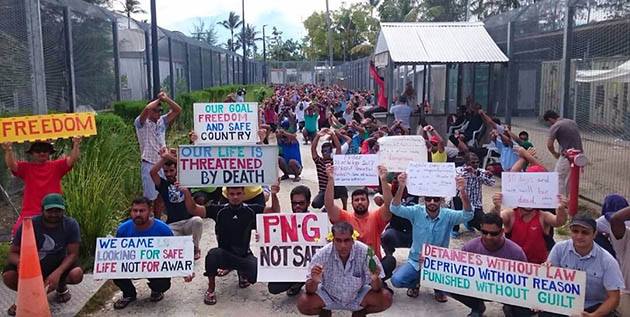
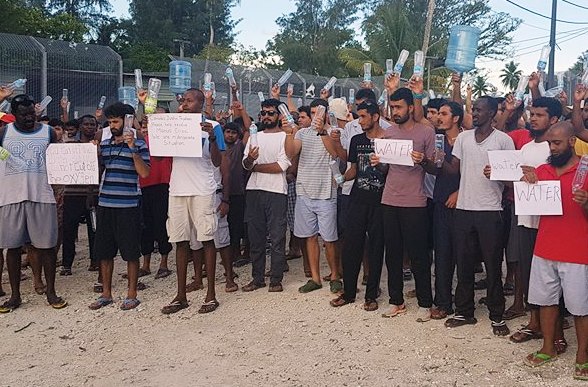
    In January 2015, the largest hunger strike of more than 900 men lasted for half the month on Manus Island. Photos and videos smuggled out showed men digging under fences to get bottles of water which authorities were denying them as a way to pressure the men to stop their protest.

    Sky writing over Parliament House reminded politicians we had not forgotten Manus or Nauru.

    On 27 January the hunger strike ended violently. Guards in full riot gear wielding batons and shields stormed the compounds beating up unarmed, weakened men and rounding up who they thought were ringleaders. Lights had been turned off and the darkened video could only record the screams and cries for help. The “ringleaders” were initially sent to the prison in Lorengau before forced back into the detention centre.

    The previous year it had been revealed that Australia was operating a secret compound called Chauka that did not appear on any maps. It consisted of windowless shipping containers.

    Refugees from both islands were regularly medically transferred to Australia due to poor health and, usually without warning and sometimes with their treatment incomplete, whisked away in the middle of the night back to Manus or Nauru.

    In 2015 Dutton ended the policy of transferring pregnant women to Australia to give birth and, to encourage compliance with being returned to the island, regularly split families.

    In the aftermath of Reza Barati’s death the year before, some Iranian and Kurdish men had withdrawn from having their claims processed since the only prospect was resettlement in PNG or go back to their country of origin. In August 2015 three Iranian men were grabbed in quick succession. All three had passports in their surrendered personal property. The first two were pressured into signed to go back to Iran. The third didn’t sign but was forced back anyway.

    The next month all other Iranians and Kurdish asylum-seekers were brought to see immigration one at a time. The recording of one of these interviews clearly included a male and a female Australian Border Force (ABF) or Australian Federal Police officers. Also present was a female interpreter.

    Why aren’t you having your claim processed. You know that if you don’t, you’ll be sent back to danger. Do you want to be sent back to danger? If you don’t want to be sent back to danger, you should agree to have your claim processed.

    About the same time a Syrian man was forced back to Syria when the civil war was at its height and streams of refugees were fleeing towards Europe. Dutton appeared on the ABC and insisted that the return was voluntary. He was never questioned about the guards that accompanied the refugee or the attempt to escape during a stopover on the flight to Syria.

    In the second half of 2015 the Human Rights Legal Centre (HRLC) was gearing up to fight a case against the legality of detention on Nauru based on the funding arrangement. To thwart this, the government of Nauru suddenly opened the doors and declared no one was locked up despite the guards and security processes. The Coalitiion government with the help of the Labor opposition rushed through legislation to legalise the funding of offshore detention and made it retrospective.

    In February 2016 the HRLC lost their case. A Brisbane hospital refused to discharge baby Asha back into detention and this became the rallying point for the “Let Them Stay” campaign. In the aftermath, those in detention in Australia for medical reasons were slowly released into the community instead of being forced back to Manus and Nauru. Forced removals to Manus or Nauru still happened but they were less frequent. ABF increasingly sent sick refugees to Taiwan and PNG for medical treatment.

    On 29 April 2016, Omid Masoumali died in Brisbane from severe burns after self-immolating on Nauru. Malcolm Turnbull faced the cameras and told us not to get misty eyed. Dutton falsely blamed refugee advocates for encouraging self-harm. A week later a Somali girl attempted self-immolation after being forced back to Nauru but survived horrific injuries and even now requires constant care.

    In the same week the supreme court of PNG declared detention illegal and the centre on Manus was opened up to allow not only the use of mobile phones but daily buses to the local town of Lorengau.

    On 11 May,  Rakib Khan died on Nauru of unknown causes after two days of chest pains. On 2 August, Kamil Hussain died at a waterfall on Manus Island.

    The Nauru files were released detailing 2116 separate incidents of assaults, sexual abuse, child abuse and self-harm attempts at the detention centre on Nauru. Some of these were already part of the Moss report.

    In November 2016, Turnbull announced the US deal to resettle refugees after 3.5 years of telling refugees they had no hope. The Cambodian deal was a failure. And whether refugees or asylum-seekers, people were constantly pressured to go back to where they came from.

    On 24 December 2016, Faysal Ishak Ahmed died on Manus Island after months of raising health concerns that weren’t treated.

    In 2016 and 2017, refugees in both RPC 3 and RPC on Nauru protested on a daily basis at the gates of the detention centre. Much like Manus, welfare services were provided by a construction company on Nauru – Canstruct. The company, an LNP donor, was awarded well over a billion dollars.

    In 2017 it was announced that the detention centre on Manus Island would close. Tremendous pressure was put on the men to either accept resettlement in PNG or to go back to where they came from. Daily protests happened on Manus Island.

    On 7 August, 2017 Hamed Shamshiripour was found hanging in the jungle on Manus Island.

    In September 2017, Dutton announced the fast track process, which would release refugees from community detention in Australia, placing them in the position of needing accommodation and jobs while on short-term visas, alongside the cohort who arrived when Julia Gillard was Prime Minister.

    On 2 October Rajeev Rajendran was found hanging at the hospital in Lorengau.

    The compounds on Manus Island started being dismantled and bulldozed in May 2017. On 31 October all the staff left. The men were given weeks’ worth of medication and a few microwave meals. The electricity was cut. Dodgy contracts were awarded to Paladin and JDA for security services and health services changed from IHMS to PIH (Pacific International Hospital).

    The next morning Senator Nick McKim came through the gates and offered his solidarity to the remaining 450 men at the detention centre. For three weeks the men held out. Food was smuggled in. Wells were dug. Authorities smashed the water tanks. On 24 November 2017, police came in large numbers and beat all the remaining men with metal bars, broke their belongings and forced them into the three newly built detention centres at Lorengau – East Lorengau, West Lorengau Haus and Hillside Haus. Some of the accommodation was incomplete.

    On 2 November 2017, Jahangir died in a motorbike accident on Nauru.

    Since the US deal had been announced only a handful of people had been resettled in 2017. Families on Nauru worried that asking for medial help would put their US process at risk and stopped asking for help.

    In January 2018 the health of children on Nauru deteriorated further. Self-harm, attempted suicide and resignation syndrome was rife. The National Justice Project fought legal battles in courtrooms where judges ordered the government to evacuate sick children. The Kids off Nauru campaign ensured the majority of children on Nauru had been medically evacuated to Australia. But they were very badly damaged by their five-year detention experience.

    On 22 May 2018, Salim Kyawning died from head injuries after jumping from a moving bus on Manus.

    On 15 June, Fariborz Karami was found dead in his tent on Nauru.

    The Australian government still resisted bringing refugees to Australia for medical treatment.

    Morrison rolled Turnbull to become the next Prime Minister. Turnbull resigned from parliament and Dr Kerryn Phelps won the by-election for Wentworth. Early 2019, legislation commonly known as the Medevac Bill passed parliament. Sick and injured refugees began arriving in Australia but instead of receiving treatment, they were locked up in hotel detention.

    The first arrivals were sent to Kangaroo Point in Brisbane and by July 2019 refugees from both PNG and Nauru were sent to Melbourne, firstly to the Mantra Hotel in Preston and then to the Park Hotel in Carlton.

    The first releases were in December 2020, with larger groups released in January 2021. Refugees released were given six-month visas. Many still pursued permanent resettlement options in the US and now New Zealand. Funding for the remaining refugees in Port Moresby was cut in accordance with memorandums of understanding signed by the Morrison and then Albanese governments to transfer responsibility for the remaining refugees on PNG.

    Meanwhile on Nauru a perpetual agreement came into force to ensure there would always be a detention centre on the island.

    I’ll finish with what the alternative could have been. A health check. A security check. And just processing the claim for asylum in a compassionate, responsible and professional manner.

    By Margaret Sinclair
  • Explaining offshore processing

    Explaining offshore processing

    Australia has a shameful record on offshore processing of innocent asylum-seekers and refugees.

    The approach, supported by both Coalition and Labor, has led to death in some cases and physical and psychological damage in many others.

    Now other governments around the world are looking at adopting the “Australian model”.

    We are providing a link here to an article that criticises the offshore detention policy and outlines its history … and its failings.

    The article has been written by Madeline Gleeson, Senior Research Fellow at the Kaldor Centre for International Refugee Law, UNSW Sydney, and Natasha Yacoub, Visiting Research Fellow at the Refugee Studies Centre, Oxford Department of International Development, University of Oxford.

    Read the article.

  • Open letter to Foreign Minister Penny Wong

    Open letter to Foreign Minister Penny Wong

    Open letter to Australian Foreign Minister Penny Wong from Refugee Action Collective – Vic

    Re: Urgent call to continue funding United Nations Relief and Works Agency (UNRWA)

    Dear Minister Penny Wong,

    The recent decision to suspend aid to the United Nations Relief and Works Agency (UNRWA) is wrong and funding must be resumed as a priority.

    We note the suspension is in relation to unproven accusations of the involvement by a small number of staff members in the October 7 attack by Hamas on Israel, an attack that UNRWA condemned.

    This decision is both unjustified and will result in further needless suffering by the Palestinians in Gaza.

    UNRWA employs approximately 30,000 people, 13,000 in Gaza alone. Why should the organisation and the people of Gaza be subjected to collective punishment because of the alleged actions of a handful of people?

    UNRWA provides aid and service to millions of people, how is it expected to continue to support those who are suffering, starving and in desperate need of medical services if funding is cut?

    While this decision may be popular in some quarters, it is times like this that Australia needs to show that it is there to support the vulnerable, the dispossessed and those living through a critical humanitarian crisis.

    We urge you to immediately reverse the decision to suspend aid.

    Regards

    The Refugee Action Collective, Victoria

  • Do our protests have an impact?

    Do our protests have an impact?

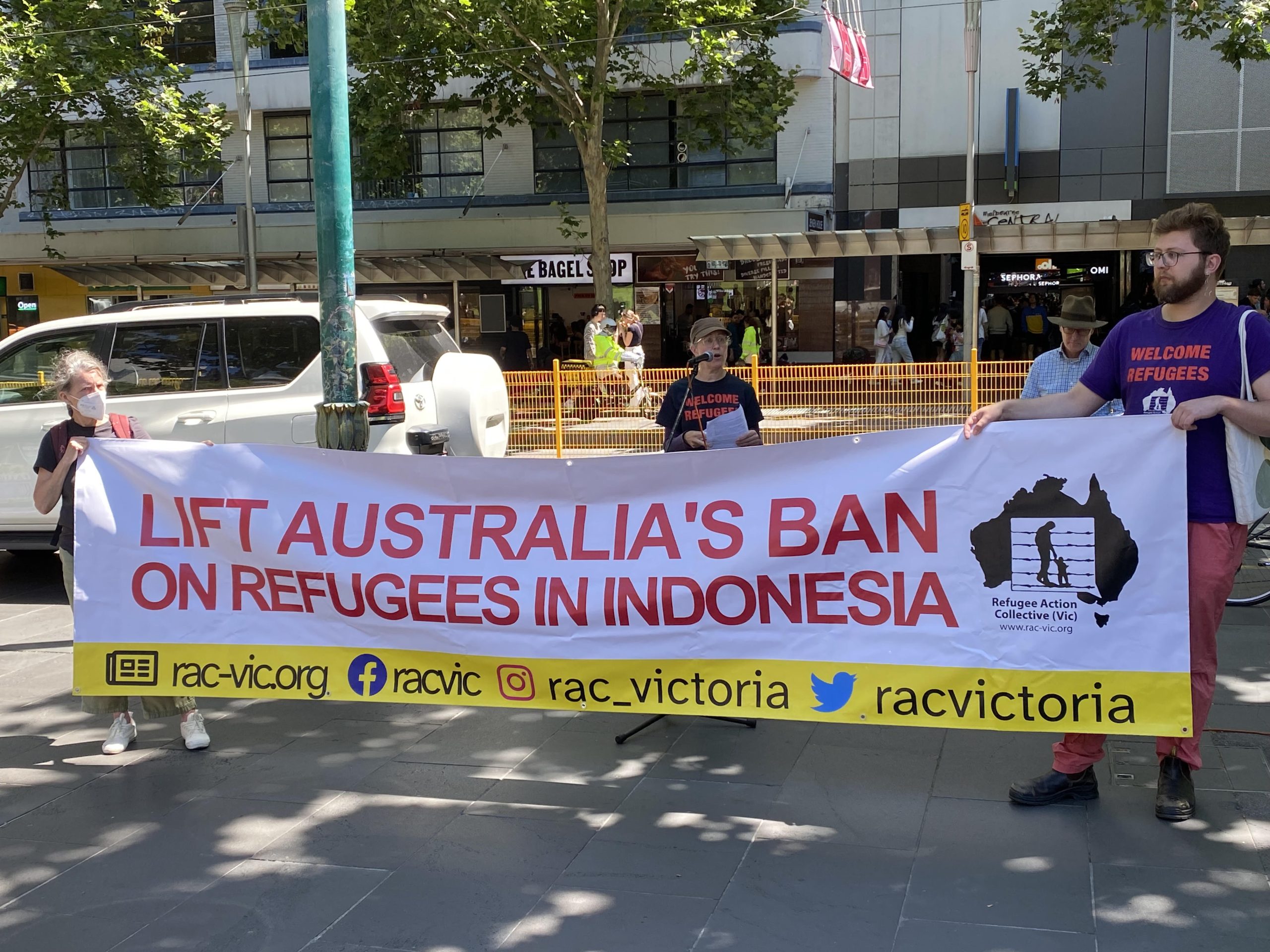
    In November 2023, RAC (Vic) held an action outside the State Library to protest the long-standing ban on refugees from Indonesia.

    In 2014 the Australian government implemented a ban on the resettlement of refugees from Indonesia.

    This meant that people who had signed up with the UNHCR in Indonesia for resettlement in Australia and who had been found to be refugees by that organisation were forbidden to do so. The Albanese government maintains the ban today.

    Indonesia is a major regional gateway for people to come to Australia from countries such as Myanmar, Sri Lanka, Bangladesh, Afghanistan, Iran and Sudan.

    As Indonesia is not a signatory to the Refugee Convention this ban has left 14,000 men, women and children in limbo. They are living in poverty with no work rights and no future.

    Most Australians would have no idea about this ban and so the situation goes largely unchallenged and unscrutinised.

    RAC (Vic) is determined to highlight this appalling situation and stand in solidarity with those currently in limbo in Indonesia.

    Although the protest drew a relatively small crowd it had a big impact on those most affected by the ban. We received dozens of messages during and after the livestream from refugees in limbo in Indonesia who were glad to see people standing in solidarity with them.

    Here are just a few quotes from refugees who either participated in the action via phone or who watched the livestream. The quotes show that our actions matter.

    They also show that those affected by Australia’s policies are people – not numbers or cases but people. These people have hopes and dreams and Australia’s brutal policies stand in the way.

    We must continue to shine a light on this injustice and build the protest against it. “From little things, big things grow.”

    We will be planning more actions in 2024. Please join us.

    To the Australian people who demonstrated for us yesterday, I am writing to you today to express my sincere gratitude for your support … You have shown us that we are not forgotten and that there are people who care about our plight … it gave us hope that one day we will be able to rebuild our lives in a safe and welcoming country. We will never forget it. (Alireza)

    Thank you for the rally and support. It came at a crucial time. People were losing hope. I hope to see more of this support. Your support is touching hearts and saving lives. (Hussain)

    Thank you for standing in solidarity with the forgotten refugees in Indonesia. (Noor)

    Sending love from Indonesia to you dear Australian kind heart people. Thanks for raise up our poor voice. We are here in Indonesia living about 11 years without any basic human rights. (Mahdi)

    We all appreciate your kindness and caring about refugees in Indonesia. Thank you so much. (Assadullah)

    By Barbara Forehan

  • The High Court decision explained

    Why have some people in detention been released?

    On 8 November 2023, the High Court of Australia held that indefinite immigration detention (i.e. where there is no end point in a person’s detention) is unlawful, and that the Australian Government cannot detain a person if they cannot be removed from Australia in certain circumstances.

    As the High Court has not yet published its written reasons, it is unclear how many people in detention are impacted by the decision and must be released. We do not know when the High Court will publish its reasons, however it is unlikely to be this year.

    During the High Court hearing, lawyers for the Minister indicated that 92 people in detention would likely be impacted by the decision, and possibly 340 other people may be affected.

    As of 18 November 2023, at least 93 people have been released from detention.

    RAC Vic welcomes the High Court decision. We have campaigned for many years for an end to the cruel policy of indefinite detention.

    Many, but not all, the people who are being released from detention have committed crimes. It is important to note that they are not being released from prison. They were moved to detention after serving their sentence.

    How did the government react?

    On 16 November 2023, the government passed a new law that applies to people released from detention because of the High Court decision.

    The law says that people released will be granted bridging R visas with additional conditions, including strict reporting requirements.

    People will also be subjected to curfew requirements and electronic monitoring devices.

    There is a process for people to request the Minister to remove these conditions if the Minister is satisfied that the person is not a risk to the community.

    Also, if people have been convicted of certain offences, their bridging visas will have conditions that prevent them being in contact with certain people in the community.

    If a person breaches these new bridging R visa conditions, it is a criminal offence, unless the person has a reasonable excuse.

    If a person breaches a visa condition over more than 1 day, each day that the person is in breach of the condition will be considered as a separate offence.

    The punishment for each offence is a minimum sentence of 1 year of imprisonment and the maximum penalty is up to 5 years’ imprisonment.

    RAC Vic believes this is a draconian response that is inherently racist – it applies only to non-citizens.

    Citizens who do jail time are released into the community once they serve their sentence, sometimes with conditions.

    Non-citizens are being treated as if they are inherently more dangerous. Home Affairs Minister Clare O’Neil responded to the High Court decision by saying that if she had her way, all the people released would be back in detention.

    Labor is pandering to racist fearmongering. This is a logical continuation of Labor’s commitment to the Coalition agenda of Operation Sovereign Borders, boat turnbacks, mandatory detention on Nauru and the continued misery for a small number of refugees in Papua New Guinea and 14,000 more in Indonesia.

    RAC will continue to campaign against this agenda, for refugees to be welcomed. We will also continue to campaign for non-citizens to be treated equally with citizens in the criminal justice system.

    • RAC acknowledges the use of an Asylum Seeker Resource Centre briefing document.
  • Refugee activists win fines case: now give refugees permanent visas

    Police have dropped charges against eight Refugee Action Collective Vic (RAC) activists who were fined for taking part in a car cavalcade on Good Friday 2020.

    Refugee supporters had formed a COVID-safe motorcade to show support for Medevac refugees held inside the Mantra Hotel in the northern Melbourne suburb of Preston.

    RAC spokesperson Lucy Honan said, “These fines should never have been imposed in the first place. They were part of a draconian and authoritarian reaction to the pandemic that saw the quashing of protest and dissent.

    “Refugee supporters argued consistently that the health and wellbeing of refugees in detention could not be ignored until the pandemic was over.

    “Our protests, including the cavalcade, were always COVID-safe. And our campaign was justified, with the Morrison government eventually freeing all refugees from hotel detention.

    “Our only ‘crime’ was to show solidarity with the refugees. It’s a disgrace that the fines were imposed and that it’s taken three and a half years for the police to drop the charges. But today we stand vindicated.”

    Honan said the police had charged about 30 people with not having a reasonable excuse to be outside the hotel even though the refugees were saying they were in urgent need of community support. Some activists had paid their fines while others were put on diversion orders with no fines after guilty pleas.

    She added, “There is a growing trend by governments across Australia to attack the right to protest and to stand up for solidarity and human rights.

    “Our victory today shows that protest is legitimate and necessary. The shocking moves by the Albanese government to undermine the High Court’s ruling to abolish indefinite detention is just the latest indication that Labor wants to keep every facet of the Liberals’ inhuman anti-refugee policies in place.

    “RAC will continue to be on the streets arguing for permanent visas for the Medevac refugees and for all victims of Australia’s cruel border control policies.”

    For background on the case, visit https://rac-vic.oncal.link/defend-the-right-to-protest-free-the-refugees/

    Organisations that backed the campaign to drop the charges included:

    • Maritime Union of Australia
    • United Workers Union
    • Australian Education Union Victoria Branch
    • Health and Community Services Union
    • CFMEU Construction & General Division VIC/TAS Branch
    • NTEU Victorian Division
    • ETU Queensland and NT Branch
    • Ballarat Regional Trades and Labour Council
    • RMIT University NTEU branch committee
    • Federation University NTEU branch committee
    • The Victorian Greens
    • Tamil Refugee Council
  • Vale Father Bob: refugee supporter

    Vale Father Bob: refugee supporter

    Father Bob Maguire was an advocate for the poor, the homeless and those who were marginalised by society.

    He was also a fierce advocate for refugee rights. 

    Many will have seen him at the Park Hotel/Prison last year at age 87, when he entered the cage in solidarity with the men held in the Park.

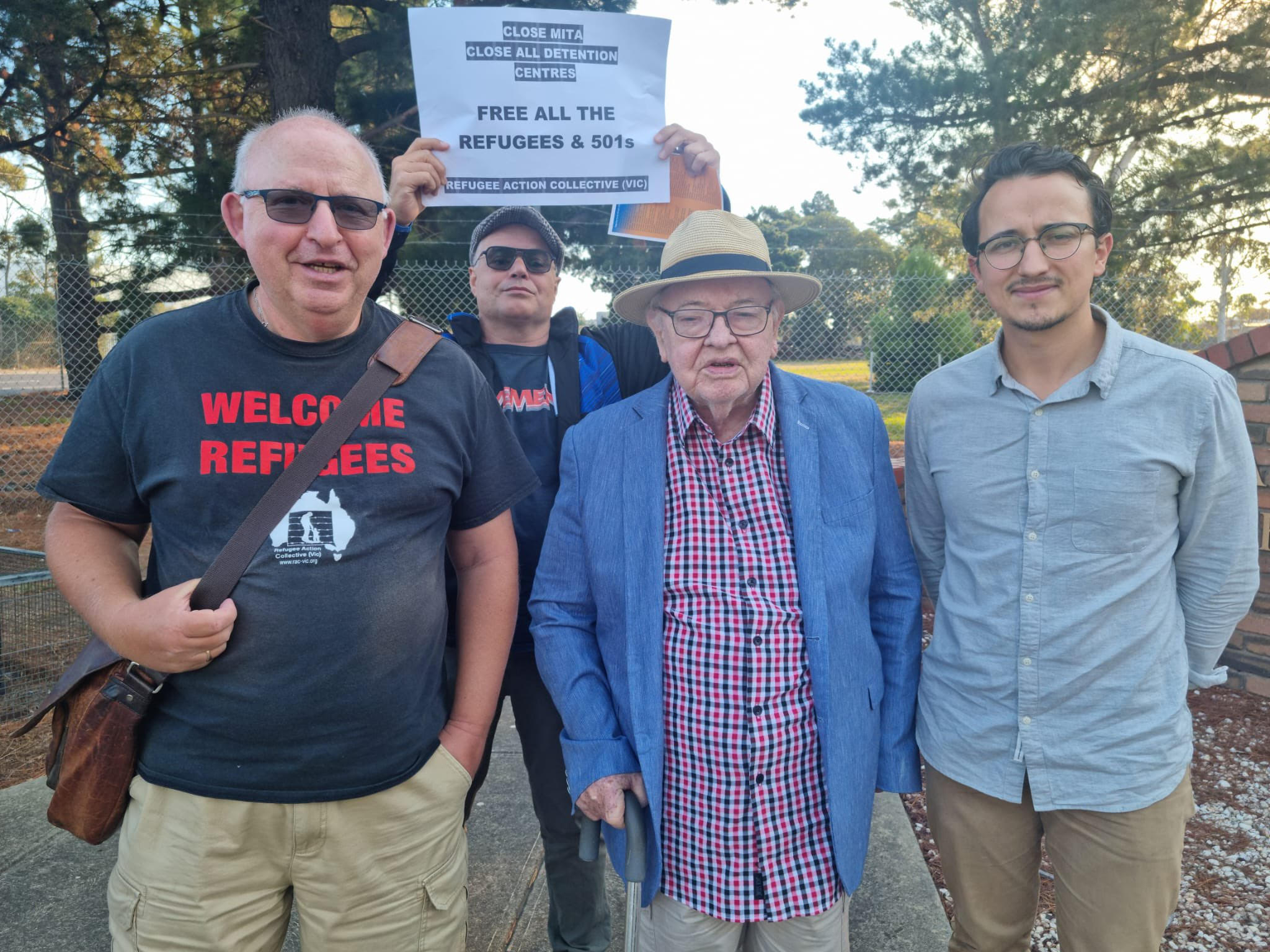
    Again last year, Father Bob accepted RAC’s invitation to speak at the MITA detention centre against the incarceration of refugees and the 501s. (See photo.)

    Father Bob’s connection and advocacy with RAC dates back to 2017.

    On 2 September 2017, RAC called an action outside State Parliament under the slogan, LET THEM STAY-MAKE THEM WELCOME-BRING THEM HERE.

    The speaking list at the event was: Aran Mylvaganam – Tamil refugee; Andrew Giles – then shadow Immigration Minister; Dr Helen Driscoll – trauma psychiatrist; Shawfikul Islam – Rohingyan refugee; and a late inclusion, Father Bob.

    A message was left by Father Bob’s assistant that he couldn’t speak at the protest because he had two weddings to perform on that day.

    I called back to thank the assistant for getting back to me, but to my surprise Father Bob picked up the phone, we had a long chat and he asked lots of questions about RAC. 

    At the end of our chat he said he would come and speak at the protest before the weddings, but warned he would need to make a quick getaway to make it on time for the weddings.

    There was a huge police presence at the protest, nothing out of the ordinary, but what was extraordinary was that l had three policemen come up to me wanting to find out whether it was true that Father Bob was going to speak. It appeared they were fans.

    Needless to say, the police on the day were quite friendly.

    Thank you for you love and solidarity, Father Bob. Vale.

    Helen Panopoulos, on behalf of RAC

  • Three years on, still fighting for the right to support refugees

    On Tuesday 7 March the RAC activists who had been fined in 2020 for our car cavalcade outside the Mantra Hotel, to show support for Medevac refugees detained there, went to Heidelberg Court for a contest mention. We held a brief protest out the front.

    The magistrate listened to our lawyer summarise our case: that we were exercising “care and compassion”, one of the permitted reasons for leaving the house, and that we were volunteering as RAC volunteers, again another permitted reason for leaving the house. 

    The magistrate asked a few questions, and then asked the police why it was in the public interest to pursue us.

    He told the prosecutor to go away and make phone calls to ensure that she really did have instructions to pursue the case. 

    We came back after lunch to hear that yes, she really did have those instructions. She confirmed that our case was with “senior legal” because of its high profile. 

    The magistrate set yet another mention for 5 May, one last chance for the police to drop it. 

    Then the magistrate dealt with two of our party who wanted a sentence indication. He essentially gave them a “proven” with no sentence. So they don’t have to pay their fines, and they don’t have a “guilty” conviction recorded either. Another slap to the prosecutors. 

    RAC activists don’t have to attend on 5 May, so there won’t be a protest. But once we have a date for the real hearing then we’ll welcome as many people as possible to stand up for the right to show solidarity with refugees.

    Read more about the case.

  • Finally, good news for 19,000 refugees – now give permanent visas for all

    13 February 2023

    The announcement that the more than 19,000 refugees on temporary and safe haven visas (TPVs and SHEVs) will finally be able to get permanent residency is welcome but long overdue.

    After 10 years or more in limbo, refugees will now be able to plan their lives, get permanent jobs, attend university, travel overseas and sponsor family members to join them.

    But the decision could and should have been much quicker – Labor gave the Biloela family permanent protection in a matter of weeks.

    Now, nine months after winning the election, Labor is asking refugees to apply for a Resolution of Status (RoS) visa, a process that will see some refugees waiting for an outcome until this time next year.

    But this is far from the end of the campaign for refugee rights.

    Labor has not abolished TPVs and SHEVs – furthermore, it has just renewed the status of Nauru as an offshore processing island and is paying a company more than $400 million to maintain an empty detention centre for possible use.

    While Immigration Minister Andrew Giles announced the good news, Home Affairs Minister Clare O’Neil played hard cop to his soft cop, threatening anyone who attempts to arrive by boat.

    Labor continues to support Operation Sovereign Borders, which includes boat turnbacks and offshore detention, with no path to residency.

    A the same time, Labor is offering nothing to those rejected as refugees under the flawed fast track process, and it has nothing to say to refugees and asylum-seekers who were deported to Nauru or Papua New Guinea and who are still stuck there.

    Labor is also silent on the fate of refuges who were sent offshore and who have since been brought to Australia for medical treatment. Medevac refugees like Farhad Bandesh and Mostafa Azimitabar, who have built new lives in Australia, still have no path to permanent protection.

    And we must not forget the 14,000 refugees trapped in Indonesia, who were barred from Australia by Tony Abbott and Scott Morrison.

    RAC welcomes the 19,000 refugees who are celebrating today’s announcement as sisters and brothers in our communities.

    But we will continue to campaign for an end to Operation Sovereign Borders, for the lifting of the ban on refugees in Indonesia, and for permanent visas for everyone who is caught up in the hell of Australia’s refugee policy.

    We call on all refugee supporters to join the Palm Sunday rally at 1pm at the State Library on 2 April, to send a clear message – permanent visas for all. None of us are free until we are all free.

  • RAC calls for migration system that respects refugees

    RAC Vic has made a submission to the Department of Home Affairs review of Australia’s migration system.

    RAC’s recommendations include:

    • all refugees and asylum-seekers remaining in PNG or Nauru be brought here ASAP
    • all amendments to the Migration Act that inserted or further “strengthened” sections 501 and 116 (and closely related provisions) be repealed
    • the Migration Act’s Refugee Convention-based definition of “refugee” be extended to cover people forced to leave their country due to the effects of climate change
    • all refugees and asylum-seekers who arrive in Australia receive the humanitarian program’s level of support and benefits
    • permanent visas be granted ASAP to the following non-citizens: refugees and asylum-seekers denied justice by the unfair “Fast Track” system; all those who were or are detained in Australia, Nauru or PNG; and those on TPVs, SHEVs, and Bridging Visas.

    Read the RAC submission in full.